


Table of Contents
Recording quality demos at home just got simpler. I’ve been testing the Audio-Technica AT2020 studio XLR microphone, and I’m impressed by its its ability to deliver detailed, clear sound at an entry-level price point.
If you’re building your first home studio or looking to upgrade from a basic USB mic, this review will explore why the AT2020 remains a solid choice.
Why the AT2020 stands out
The AT2020 is a cardioid condenser microphone designed to capture vocals with clarity and warmth. I’ve worked with pricier mics, but the AT2020 holds its own. Built to last, it has a robust metal body that feels solid. Even after a few knocks, it’s performing well.
 Audio-Technica AT2020 Cardioid Condenser Microphone
 Known for its affordability and high-quality audio, the AT2020 captures vocals and instruments with clarity and detail, making it an excellent choice for musicians recording at home.
- Clear, crisp sound quality delivers detailed vocal recordings
- Sturdy metal build withstands regular studio use
- Excellent value for money in budget category
- Versatile for vocals, acoustic guitar, and room miking
- Low self-noise ensures clean recordings
- Requires audio interface with phantom power
- No pop shield included (essential for vocal recordings)
- Bright tone may need EQ adjustments for some voices
- No shock mount included with basic stand mount
- Sensitive to room noise in untreated spaces
Overview
The AT2020 is a jack-of-all-trades in my home studio. I’ve used it for vocals, acoustic guitar, and even as a room mic for drums. Its cardioid polar pattern helps reject unwanted sounds, which is great for small spaces.
Its all-metal body is sturdy enough to withstand a few drops. The need for phantom power means an audio interface is required, but that’s standard for most condenser mics.
For its price, the AT2020 offers impressive sound quality. I’ve used it on many home recordings and have been consistently pleased with its performance.
Current price and value
The Audio-Technica AT2020 typically retails for £80-£100 in the UK, $99-$129 in the US. At this price point, it offers exceptional value compared to entry-level USB mics (£50-£80) that lack the audio quality, and mid-range condensers (£150-£250) that may not justify the extra cost for beginners.
Microphone setup
The AT2020 is a true studio XLR microphone, not a USB mic, which means it requires an audio interface and phantom power. This setup often yields more authentic sound and more nuanced recordings.
You will need:
- Audio interface: Provides 48V phantom power and connects the mic to your computer
- XLR cable: Standard three-pin cable (use a quality one to prevent interference)
- Microphone stand: The AT2020 comes with a pivoting stand mount, but you’ll need a proper stand
 |  |  |  |  |
$299.00 | $195.90 | $224.99 | $95.07 | $43.90 |
Simply mount the mic, connect the XLR cable to your interface, and engage the phantom power button. The mic has no onboard controls – no frequency switches or volume dials to fiddle with. All gain and EQ adjustments happen at your interface or in your software. This pure signal approach gives you complete control over your sound.
Audio setup tips
Your audio setup plays a crucial role in the final sound. While the AT2020 excels at isolation of desired sound source thanks to its cardioid pattern, a few tweaks to your recording environment will maximise its performance:
- Room treatment: Even basic acoustic panels or foam can reduce reflections and tighten your recordings
- Reflection filter: Consider placing one behind the mic to minimize room ambience (though not essential for treated spaces)
- Mind the proximity effect: Getting too close (under 10cm) boosts bass frequencies unnaturally, so maintain that 15-20cm sweet spot
Audio quality
In my experience, The AT2020 handles both soft whispers and belted notes well. Its moderate sensitivity suits various recording environments.
For studio vocals or acoustic instruments, the AT2020 delivers well-balanced sound that’s rarely boomy or harsh. Mids are present but not muddy, and there’s just enough low end to give body to vocals. When recording acoustic guitar or mandolin, the mic captures the transient details beautifully without becoming muddy.
I once recorded a metal screamer with this mic. The vocals were clean and powerful, with no unwanted distortion. The AT2020 shines in both soft and loud scenarios – versatile enough for whisper-quiet folk songs and hard-hitting rock tracks.
The cardioid pattern excels at pickup of sounds directly in front whilst rejecting off-axis noise. This focused sound isolation helps achieve clean recordings even in home studios lacking full soundproofing. The microphone’s transient response is particularly impressive – it captures the initial attack of acoustic guitar strings or the snap of a snare drum with accuracy.
Its low-mass diaphragm and high SPL handling enable the mic to tackle a wide range of sources. It didn’t distort when recording a belting vocalist or a punchy acoustic guitar. The wide dynamic range captures subtle details too.
Why it’s great for high sound pressure levels:
- Handles up to 144 dB SPL
- Low-mass diaphragm provides detailed sound without distortion
- Wide frequency range (20Hz-20kHz) captures everything from subtle nuances to loud sounds
- Perfect for recording drums or brass instruments
When it comes to plosive sounds, I recommend using an external pop filter to manage those pesky “P” and “B” bursts. A pop shield with finer mesh or a secondary layer of fabric can make a big difference in achieving clean sound.
For the money, the AT2020’s audio clarity is hard to beat.
Durability and build quality
The AT2020’s metal grille and robust body give it a premium feel designed for durability against knocks and drops. Though it’s not on the same level as a Neumann U87 or some of Audio-Technica’s more up-market microphones, it’s very sturdy for a budget microphone.
Comparing the AT2020 to other popular Microphones
- Rode NT1: Known for extremely low self-noise and a more neutral tone. The AT2020 is often described as a bit brighter, making it better for certain vocals that need extra presence.
- USB Microphones (e.g., Blue Yeti): More convenient to set up via USB connections, but many users eventually switch to an XLR-based condenser microphone like the AT2020 for smoother sound and more flexibility in a studio setting.
- Dynamic Microphones (e.g., Shure SM58): Great for live shows or extremely loud sounds, but for studio vocals and acoustic instruments, the AT2020’s clarity often wins out.
 |  |  |  |
$264.49 | $127.99 | $79.00 | $135.00 |
My verdict: Is the AT2020 worth it?
If you’re looking for an affordable condenser microphone with detailed sound, it’s a commendable choice – especially for those wanting to upgrade from an entry-level USB mic.
What you get:
- Clear, crisp, top-end clarity for studio vocals
- Handles loud sounds with minimal distortion on instruments
- Excellent value for money for those on a tight budget
The absence of frequency switches and volume dials isn’t a limitation – it’s a design choice that keeps the signal path pure and shifts control to where it belongs: your interface and DAW.
Pro Tip: Pair it with a decent audio interface and maybe a Rode NT1 in a mic shootout if you want to explore alternative tonalities. And if you’re really curious about high-end gear, you can compare it to a Neumann U87 for perspective – but that’s a different price league altogether.
Clear, crisp sound quality: Delivers clarity and warmth for vocals.
Sturdy build: Can handle knocks and is built to last.
Excellent value for money: Great performance for its price.
Versatile: Works well for vocals, acoustic guitar, and room miking.
Low self-noise: Ensures cleaner recordings.
Needs phantom power: Requires an audio interface for operation.
Lacks built-in pop filter: Prone to plosives without external filtering.
Bright tone: Great for clarity but may need EQ adjustments.
No shock mount included: Basic stand mount provided instead.
Room noise sensitivity: Picks up ambient sounds in untreated spaces.
Final thoughts
The Audio-Technica AT2020 is a cardioid microphone that offers detailed sound at a fraction of the price of high-end studio microphones. It’s an affordable studio microphone with a reliable build, requiring only a quality XLR cable and some basic acoustic treatment to excel.
It’s the perfect tool for the aspiring YouTube musician, or producer who needs detailed sound without breaking the bank.
Just remember you’ll need phantom power and an external pop filter to truly maximise its performance. If you want to get a better sound, consider investing in some acoustic treatment as well.
Scoring
| Criterion | Score | Weight | Weighted Score |
|---|---|---|---|
| Sound Quality | 8 | 30% | 2.4 |
| Ease of Use | 8 | 20% | 1.6 |
| Features | 7 | 15% | 1.05 |
| Build Quality | 9 | 15% | 1.35 |
| Value for Money | 10 | 10% | 1.0 |
| Compatibility | 7 | 5% | 0.35 |
| Innovation | 6 | 5% | 0.3 |
| Total Score | 8.05 | ||
AT2020 technical specifications
| Specification | Details |
| Type | Cardioid condenser microphone |
| Polar Pattern | Cardioid |
| Frequency Response | 20Hz – 20kHz |
| Max SPL | 144 dB |
| Impedance | 100 ohms |
| Requires Phantom Power | Yes (48V) |
| Connector | XLR (3-pin) |
| Weight | 345g |
| Dimensions | 160mm length, 52mm diameter |
Frequently asked questions
Like most cardioid condenser microphones, the AT2020 exhibits proximity effect – a boost in bass frequencies when you get very close to the mic. This can add warmth to thin voices, but too much proximity (under 10cm) can make vocals sound boomy.
For a balanced tone, maintain 15-20cm distance. If you want more bass presence, move slightly closer; for a leaner sound, back off to 25-30cm.
The AT2020 has a frequency response of 20Hz to 20kHz. This wide range captures the full spectrum of human hearing.
In practice, this means:
Clear highs without harshness
Balanced mids for natural-sounding vocals
Solid low-end response
The slight boost in the upper mids adds presence to vocals, helping them cut through a mix without needing much EQ.
If you’d like to see the frequency response curves in detail, Audio-Technica provides these in the product documentation. The gentle presence peak around 5-12kHz is what gives the AT2020 its characteristic brightness without harshness.
To get the most out of your AT2020, I suggest:
Shock mount to reduce vibrations
Pop filter for cleaner vocal takes
Sturdy microphone stand
XLR cable (high quality)
Acoustic treatment for your recording space
These additions will help you capture cleaner, more professional-sounding recordings.
The AT2020 pairs nicely with most modern audio interfaces that supply phantom power. Here are some solid options for home studio musicians:
Budget-friendly (under £100):
Focusrite Scarlett Solo (3rd Gen) – Clean preamps and plenty of gain for the AT2020
Behringer U-Phoria UM2 – Basic but gets the job done if money’s tight
Mid-range (£100-£200):
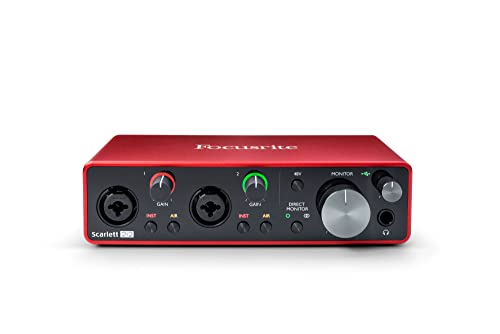
Focusrite Scarlett 2i2 – Two inputs if you want to record guitar and vocals simultaneously
PreSonus AudioBox USB 96 – Reliable with low latency
If you’re splashing out (£200+):
Universal Audio Volt 276 – Vintage preamp mode adds warmth
Audient iD4 MkII – Exceptional preamps that really bring out the AT2020’s detail
The key is ensuring your interface provides 48V phantom power and has enough gain. The AT2020 isn’t particularly demanding, so even budget interfaces handle it well. I’ve used mine with a Scarlett 2i2 for years without issues.
Pro tip: Avoid the cheapest interfaces with noisy preamps – they’ll undermine the AT2020’s clean sound. Stick with reputable brands and you’ll be sorted.
